Water main repair costs in Canada vary considerably — and not always in ways that homeowners expect. Two properties on the same street can face very different costs for what appears to be the same problem, because the factors that drive the price often have less to do with the pipe itself than with the conditions around it.
This article breaks down the main cost drivers clearly. The goal is to give you a framework for understanding why estimates vary and what questions to ask, not to give you numbers that may bear no resemblance to your specific situation.
Pipe Length and Depth
These two variables are often the starting point for any cost calculation. The service line running from the municipal main to your home can range from a few metres to 30 metres or more, depending on where the main runs relative to the house and how the property is laid out. Longer pipes mean more excavation, more material, and more labour time — so the linear footage is a primary cost driver.
Depth adds complexity in a different way. In Ontario and most of Canada, water mains must be buried below the frost line to prevent freezing — typically 1.5 to 2.5 metres, though deeper in some northern areas. Greater depth means more soil removal per metre of pipe, requires more careful shoring and safety compliance during excavation, and increases the time required for each stage of the work. A pipe sitting at 2.5 metres depth costs more to access than one at 1.5 metres, all else being equal.
Soil Conditions
Soil is one of the most underappreciated cost factors in this kind of work. The range of soil conditions across Ontario is significant — from sandy loam that excavates easily to dense clay, compacted fill, or rocky ground that requires different equipment and much longer dig times.
Clay Soil
Much of southern Ontario, including the area around Lake Ontario and into the Niagara region, has significant clay content. Dense clay is slower to excavate than sandy soil, heavier to remove, and can be more unstable when wet. It also tends to hold water, which means a leak will saturate clay soil thoroughly and can make excavation muddier and more complicated.
Rocky Ground
Properties near the Canadian Shield or with significant shale or rock content can face substantially higher excavation costs. Where conventional digging equipment struggles, specialized rock-cutting equipment is needed — at higher day rates and with slower progress per metre.
Previously Disturbed or Fill Soil
Older urban properties sometimes sit on fill material — soil brought in from elsewhere, sometimes decades ago, sometimes containing debris. Fill is unpredictable: it may be easy to dig or it may contain unexpected obstructions. Properties near former industrial sites can have fill that requires more careful handling.
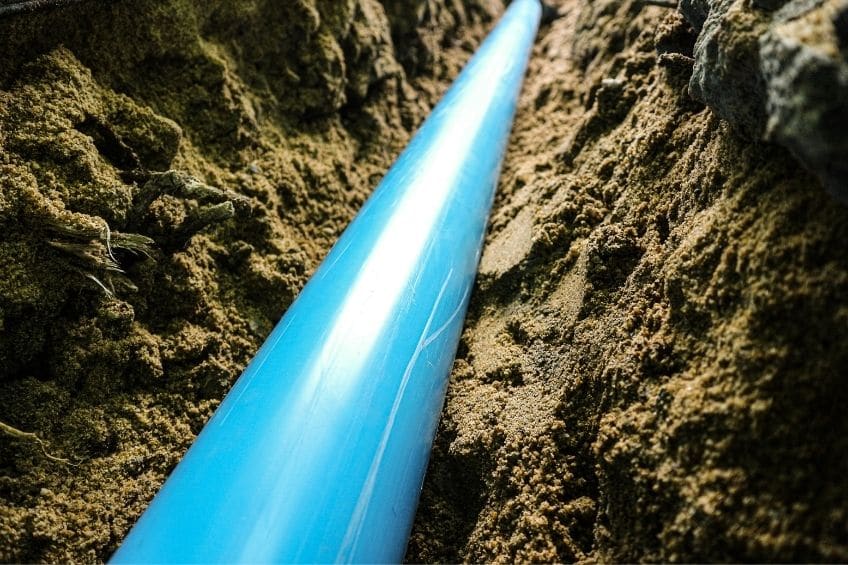 Soil conditions are rarely obvious from the surface. What's below a standard lawn can vary significantly, and this affects excavation time and cost.
Surface Materials and Reinstatement
What's above the pipe matters as much as what's around it. Reinstatement — restoring the surface after work is complete — can represent a substantial portion of total project cost, particularly for properties with concrete driveways, interlocking pavers, or elaborate landscaping.
Lawn and Garden
The least expensive surface to reinstate. Topsoil is brought in, the area is graded, and grass seed or sod is applied. Sod provides faster visual recovery than seed but costs more.
Asphalt Driveway
More expensive than lawn reinstatement. The trench area needs to be properly compacted, a granular sub-base laid, and new asphalt applied. Matching existing asphalt is challenging — new sections are visibly different from weathered asphalt, which is often just the reality of the work.
Concrete and Interlocking Stone
Concrete driveways require careful cutting before excavation (to limit crack propagation) and forming and pouring of new concrete after. Interlocking stone can be lifted, stored, and relaid if done carefully, but the labour involved is significant. Either way, this category adds meaningful cost compared to asphalt or lawn reinstatement.
Access and Site Conditions
The physical ability to get equipment to the work area affects both cost and method selection. A detached house with an open lawn on the property edge is straightforward to access. A semi-detached or row house where the service line runs through a narrow side yard, under a deck, or beneath a finished basement floor presents access challenges that increase complexity and cost.
Properties where excavation equipment can't get close to the work area may require hand-digging for portions of the job — slower and more labour-intensive than machine excavation. The logistics of disposing of excavated soil, managing traffic or pedestrian movement on urban streets, and protecting neighbouring properties also factor into site-specific cost.
Municipal Permits and Road Work
In Ontario, most water main work that touches a municipal right-of-way (the strip of land between the street and the property line, which often contains the sidewalk and part of the lawn) requires a permit from the municipality. These permits have application fees and often require compliant traffic management if work affects the road or walkway.
If the service connection point — where your private line joins the municipal main — requires work in the road itself, road opening permits are needed, and in some municipalities, the homeowner is responsible for road restoration to specified standards. These costs are real and specific to each municipality's requirements.
- Pipe length (linear metres to be repaired or replaced)
- Pipe depth (deeper = more excavation cost per metre)
- Soil type (clay, rocky, fill — each adds complexity)
- Surface reinstatement (lawn vs. asphalt vs. concrete vs. interlocking)
- Site access (wide open vs. restricted, side yard, urban)
- Municipal permits and road opening requirements
- Pipe material for replacement (copper, HDPE, etc.)
- Whether trenchless is viable (affects labour and reinstatement cost)
- Proximity to other underground utilities
- Seasonal timing (frozen ground adds difficulty)
Pipe Material
The material chosen for replacement affects both material cost and longevity. The most common materials for residential service lines today are copper and HDPE (high-density polyethylene). Copper remains a widely accepted standard for residential service connections and has a long performance history. HDPE is increasingly used, particularly for trenchless applications, because of its flexibility, resistance to corrosion, and long projected service life.
Lead pipes — once common in older urban areas — should be replaced rather than repaired, given the health implications of lead in drinking water. Lead service line replacement programs exist in some Ontario municipalities, and it's worth checking whether any cost-sharing programs apply to your property.
Method: Trenchless vs. Open-Cut
The method used affects the overall cost profile, though not always in the direction people expect. Trenchless methods (where applicable) often cost more in terms of the specific pipe work itself but significantly less in reinstatement costs — because you're only restoring two small access pits rather than a full trench. The net result depends heavily on what's above the pipe.
For a pipe running under a concrete driveway, trenchless can be substantially less expensive overall because the savings on concrete reinstatement are significant. For a pipe running under a simple lawn, the cost difference may be less pronounced.
Seasonal Timing
Water main work in Ontario can be done year-round, but winter conditions add complexity and cost. Frozen ground requires thawing or specialised equipment to break up. Working in cold conditions is slower, and proper backfill compaction is harder to achieve with frozen soil. Where there's flexibility in timing, spring through autumn is generally more straightforward — though circumstances don't always allow for choosing the most convenient season.
Getting a Realistic Assessment
The most reliable way to understand what a repair will cost for your property is to have someone assess the actual conditions: pipe location, depth, soil type, surface features, and access. A desktop estimate based on property type alone is difficult to make meaningfully accurate.
When comparing quotes, it's worth making sure each one covers the same scope — including reinstatement, permits, and site management — rather than comparing just the pipe work. What looks like the lowest quote can look different once you understand what's included and what isn't.
Want a better sense of what applies to your property?
Describe your situation and we'll help you understand the factors that are likely to apply — without pressure or inflated framing.
Get in Touch