When homeowners hear "trenchless repair," they often picture a technology that makes water main work invisible — no mess, no disruption, done in a day. The reality is more nuanced. Trenchless methods are genuinely valuable and have changed what's possible for many types of jobs, but they're not appropriate for every situation, and understanding the difference matters when you're trying to figure out what your options actually are.
This article walks through the main trenchless methods used in residential water main work, how each one functions, what conditions make them viable, and — just as importantly — what rules a trenchless approach out.
What "Trenchless" Actually Means
Traditional water main work involves excavating a trench along the length of the pipe — digging up the lawn, driveway, or other surface material, replacing or repairing the pipe, and then reinstating everything above it. It works, but it's disruptive and the reinstatement (especially for driveways, interlocking stone, or landscaping) adds significant cost and recovery time.
Trenchless methods aim to do the necessary work through small access points rather than an open trench. Instead of exposing the entire pipe, you dig one or two pits — typically one at each end of the affected section — and run equipment through the pipe from there. This means less surface disruption, faster work time, and in many cases lower overall reinstatement cost.
There are two main categories of trenchless work relevant to residential water mains: pipe lining (where a new pipe is formed inside the existing one) and pipe bursting (where the existing pipe is fractured outward and a new pipe is pulled through in its place).
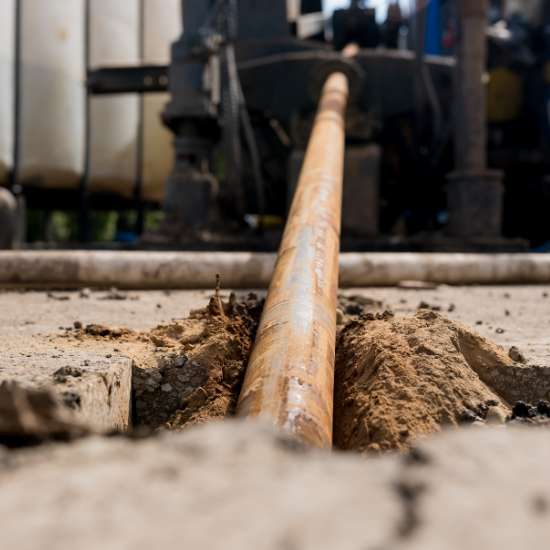 Even trenchless jobs require excavation at access points — typically small pits at each end of the affected section, rather than a full-length trench.
Cured-in-Place Pipe Lining (CIPP)
Cured-in-place pipe lining — often referred to as CIPP or pipe lining — is exactly what the name describes. A flexible liner, saturated with a resin material, is inserted into the existing pipe and inflated so it presses against the inner wall. The resin then cures (hardens) into a new, continuous pipe inside the old one.
The result is a structurally sound pipe within a pipe. The new liner is smooth, corrosion-resistant, and can seal cracks, fractures, and gaps in the host pipe. It effectively creates a new water carrier without requiring the old pipe to be removed.
When CIPP Works Well
CIPP is most effective on pipes that are structurally degraded but still largely intact — meaning the pipe hasn't collapsed and maintains a continuous path that the liner can follow. It works well for pipes that have developed cracks, minor corrosion, or joint failures, particularly in materials like clay, concrete, or cast iron that degrade in predictable ways.
It's also a reasonable option when the pipe runs under features that would be expensive or complex to reinstate — interlocking stone driveways, mature landscaping, or structures that can't easily be removed and replaced.
Limitations of CIPP
Because the liner is formed inside the existing pipe, it slightly reduces the internal diameter. For mains that are already undersized, this may affect flow capacity. Additionally, if the existing pipe has multiple significant bends or offset joints, the liner may not conform fully, leaving potential weak points.
CIPP is not suitable where the host pipe has collapsed — the liner needs a continuous passage to travel through. Heavily corroded pipes that have significant missing sections, or pipes with severe root intrusion, may not hold a liner properly.
Pipe Bursting
Pipe bursting takes a different approach. Rather than working inside the existing pipe, it destroys it. A bursting head — a cone-shaped tool — is drawn through the old pipe using a rod or cable pulled from the destination pit. As the head passes through, it fractures the existing pipe outward into the surrounding soil, displacing it. At the same time, a new pipe is attached to the back of the head and pulled in behind it.
When the process is complete, the old pipe is gone — fragmented into the surrounding soil — and a continuous new pipe sits in its place. The new pipe is typically HDPE (high-density polyethylene), which is flexible, durable, and resistant to the kind of joint failures and corrosion that affect older materials.
When Pipe Bursting Works Well
Pipe bursting is particularly well suited to pipes that are too deteriorated for lining — pipes with significant cracks, heavy corrosion, or material failures that wouldn't hold a liner. It also allows for upsizing: because the bursting head pushes outward, it creates space for a slightly larger replacement pipe, which can address capacity issues at the same time as the structural repair.
It works in most soil types, though particularly hard or rocky soils may increase resistance and complexity. It's commonly used on clay tile, cast iron, and older steel water mains.
Limitations of Pipe Bursting
Pipe bursting is less suitable in situations where there are other utilities running parallel to and close to the water main. The outward displacement of fragments can affect nearby pipes or cables if separation distances are insufficient. Site assessment needs to include a clear picture of what else is in the ground near the affected main.
It also requires clear, reasonably straight access between the two pits. Significant bends or changes in direction — particularly right angles — complicate the process and may require additional access points or a conventional approach for that section.
| Method | What happens to old pipe | Best for |
|---|---|---|
| CIPP Lining | Stays in place, lined inside | Cracked but intact pipes |
| Pipe Bursting | Fragmented into soil | Heavily deteriorated or undersized pipes |
Slip Lining
Slip lining is an older technique that involves inserting a smaller-diameter pipe into the existing one. Unlike CIPP, the new pipe is rigid (typically polyethylene) and is simply pushed or pulled through the host pipe, then the annular space between the two is grouted. The main drawback is a more significant reduction in pipe diameter, and it doesn't bond to the host pipe the way CIPP does. It's less commonly used for residential water mains today but remains an option in specific circumstances.
What Makes a Job Unsuitable for Trenchless Methods
This is perhaps the most practically useful part of the discussion. Trenchless is not always the right answer, and a contractor's job is to assess honestly rather than default to whichever method they prefer to offer.
Jobs that are typically unsuitable for trenchless approaches include: pipes that have collapsed (no continuous path for equipment); pipes with multiple significant bends in close proximity; situations where access pits cannot be safely excavated due to surface features or nearby structures; pipes running in extremely close proximity to other utilities with no clearance for outward displacement; and pipes that are in such poor structural condition that they won't hold a liner or provide the minimal resistance pipe bursting requires.
In these cases, conventional open-cut excavation remains the most reliable method — and being clear about that upfront is more useful to a homeowner than promising trenchless when it won't work.
The Assessment Process
Before any method is recommended, the pipe needs to be assessed. This generally involves a CCTV camera inspection — a camera is run through the pipe to document its current condition: extent of damage, pipe material, bend locations, joint condition, and any obstructions. This footage is the basis for the repair recommendation.
An honest assessment may conclude that trenchless is viable, that open-cut is more appropriate, or that the situation is borderline and both options have trade-offs worth discussing. The right answer depends on the specific pipe, not on what sounds most appealing.
Curious whether trenchless is an option for your situation?
Describe your property and what you're experiencing, and we'll give you a realistic sense of what's involved and what the options would likely be.
Contact Our Team